Enter password to view case study
Topogy
app.catalyst.io / feature-board
Role
Principal/Founding Product Designer
Team
CEO, CTO, & Me
Timeline
2wk sprint, 2026
Impact
Developed a fully AI-driven design workflow
Check out the main flow
01
The Challenge
“I'm investing in AI tools for my team, but are they helping?”
Engineering managers could see activity everywhere, but they could not easily answer the questions that mattered most:
They needed to answer everyday questions like:
Is AI helping us ship faster?
Which teams are using AI effectively?
Are we spending more on AI without improving output?
Why is this feature stuck?
GitHub showed pull requests. Jira showed tickets. AI tools showed coding sessions.
None of them connected the work into a single view of feature progress.
02
The Goal
How might we help engineering leaders quickly see what is moving, what is stuck, and where AI is helping?
We needed to help engineering leaders understand how features are progressing, where work is getting stuck, and how AI is affecting delivery.
19%
more merged PRs. AI can increase engineering output, but leaders still need to understand where that output is accelerating delivery and where it is creating new bottlenecks.
03
The Solution
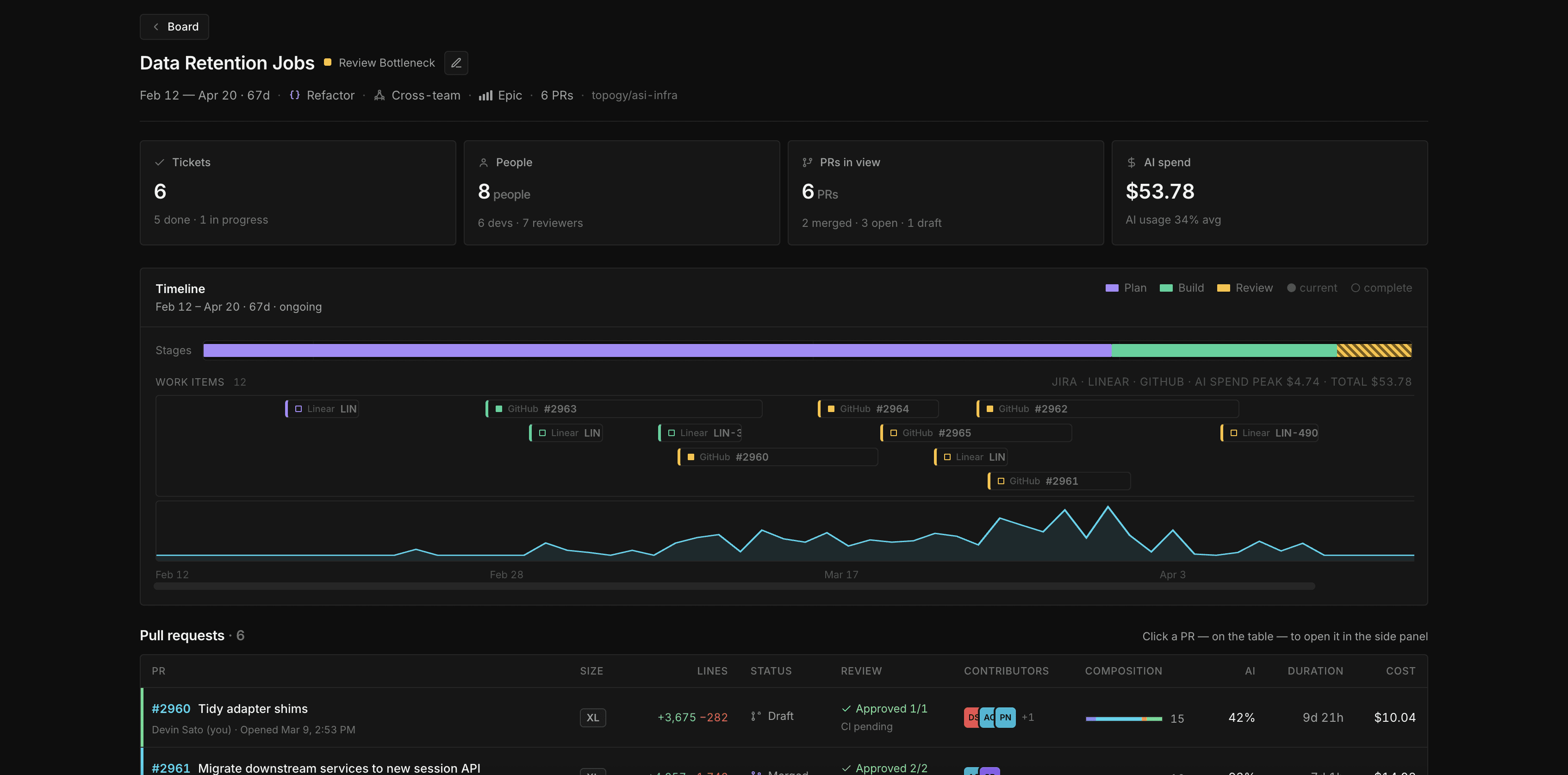
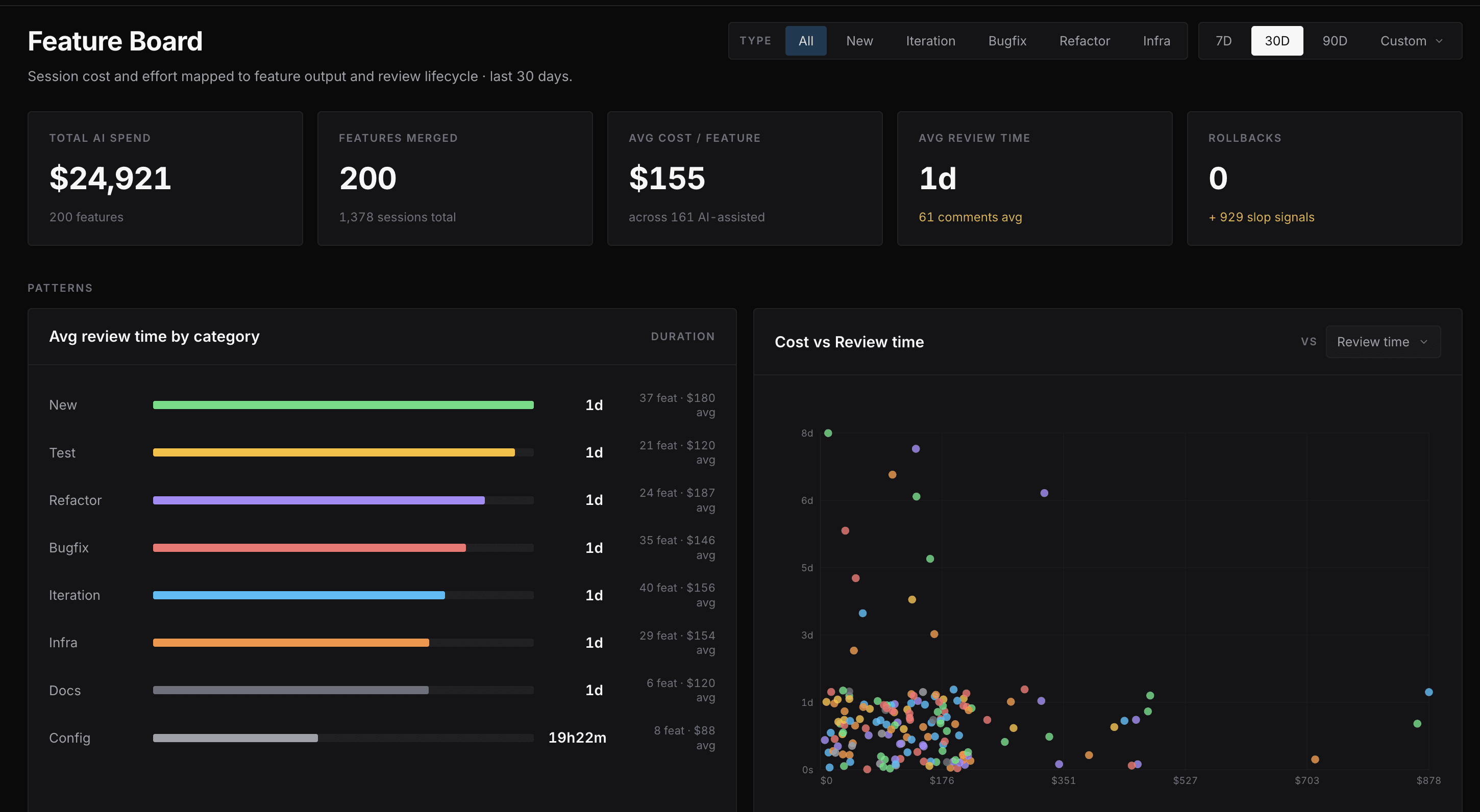
We designed the Feature Board, a living view of engineering work organized by features instead of individual pull requests.
We made AI part of the delivery story. By showing AI contribution and cost alongside feature progress, leaders could quickly see where AI was accelerating work and whether the output justified the spend.
04
The Process
I used AI for the entire process. I started my research in ChatGPT, iterated wireframes in Claude Design, used Gemini as a design-thinking partner, and finally coded the entire thing with Claude Fable.
AI helped generate interface directions, prototype interaction ideas, and compress exploration cycles from days into hours.
Since our team is made up of senior/exec-level engineers, I was able to speedrun my design process to get a develop-ready design that we can share with our investors and design partners in record speed.
I started dense, I gave our team:
AI sessions
Token usage
Generated lines of code
Review counts
Reviewer activity
Timestamps
AI contribution scores
Supporting engineering stats
It was informative. It felt exhausting.

Key insight
Everything was visible, but nothing was clear.
05
The Iteration
The live instance gave users something to play around with and visualize their own data.. that was powerful.
When our users were able to use the fully integrated Feature Board, it gave us much more valuable insights. Data is hard to visualize, so having their own projects visible allowed them to explain what we missed easier. They were not trying to analyze every metric. They were trying to understand feature health.
Two features might both take thirty days. One might spend most of that time in development. Another might spend most of it waiting for review.
Same duration.
Completely different diagnosis.

Once we simplified the view, users could easily see where AI is having an impact on their teams development and where additional opportunities for optimization arise.

Users could click into each feature and see how AI sessions, engineering activity, review timelines, and costs came together to tell the story of that feature from planning through release.

06
The Results
This feature is still evolving, but I am monitoring it's rollout success and will update this space if I find anything interesting to report.
Would I change anything?
The more I use AI, the more intentional I've become about when I use it.
It's earned a permanent place in my workflow and I've had a lot of fun experimenting with new tools, but as token costs rise and the ecosystem gets more complex, I'm finding that not every problem needs an AI solution.
The biggest lesson for me has been that AI works best as a collaborator, not a replacement. It can accelerate execution and help explore ideas, but it still takes a person to make the leap from what's already been done to what's possible next.
NEXT PROJECT
Topogy Recommendations
Helping engineering teams move from cost visibility to cost action.
Read next